I still remember the first time I pressed play on Tales from the Loop. It was a rainy weekend in 2026, and I was hunting for something that felt like the old-school science fiction I grew up loving — not a franchise explosion, not a multiverse cameo, but a quiet story about impossible machines and very human hearts. Eight episodes later, I sat in silence. Matt Reeves had already amazed me with The Batman in 2022, and I knew The Batman 2 was looming on the horizon. But this Prime Video series, which he co-produced, hit me in a way no Gotham rooftop ever could.

Most people know Reeves for reimagining one of cinema’s greatest franchises. In 2022, The Batman turned the Caped Crusader into a rain-soaked, vulnerable detective, and the sequel is still one of the most anticipated movies of the decade. Yet for sci-fi fans, Tales from the Loop is the more precious artifact. It is an overlooked masterpiece, a mind-bending exploration of science’s ability to make the impossible feel possible. It deserves a far bigger audience than it ever received.

The show was created by Nathaniel Halpern, based on Simon Stålenhag’s narrative art book of the same name. Reeves was heavily involved from the early beginnings, alongside co-producers like Mark Romanek, the director of Never Let Me Go. Together they built a fictional town in Ohio that happens to sit above a center for experimental physics. The Loop is not a weapon. It is not a portal to a superhero universe. It is a mystery that leaks into ordinary lives, turning robots, androids, and time portals into tactile, accessible parts of daily routine.
That tactile quality is where I feel Reeves’s influence most. His Planet of the Apes movies and Cloverfield share a gift for making the fantastic feel physical. In Tales from the Loop, the machines are not shiny toys. They are rusted, snow-dusted, and strangely beautiful. The result is a drama that reveals as much humanity as it does science. I found myself crying over a tractor, of all things. I found myself thinking about my own family, my own regrets, my own small loops of memory.

One reason I keep recommending it is its philosophical patience. Tales from the Loop counterposes science to nature according to the age-old traditions of sci-fi, but it does so with understated, delicate fashion. It does not shout about the conflict between innovation and the natural world. Instead, it lets us infer the potential for harmony from its moving personal stories. The conclusion I draw is simple: humanity is the ultimate bridge between nature and innovation.
Here is how I would break down its quiet power:
| Element | Why it stays with me |
|---|---|
| Visual effects | Robots and time portals feel tangible, not digital |
| Emotion | Every sci-fi idea becomes a family wound or a love story |
| Pacing | Slow, meditative, and confident in its silence |
| Themes | Memory, loss, connection, and the beauty of artificial phenomena |
| Setting | A snowy Ohio town that feels both retro and futuristic |
Despite the rare brilliance of its first season, we are still waiting for Tales from the Loop season 2, almost six years after its April 2020 release. In 2026, that wait looks even more hopeless. The show was quietly canceled by Prime Video following its initial release, due to relatively low viewing figures. No cliffhanger was resolved with a renewal. No campaign has brought it back. It remains an eight-episode hidden gem.
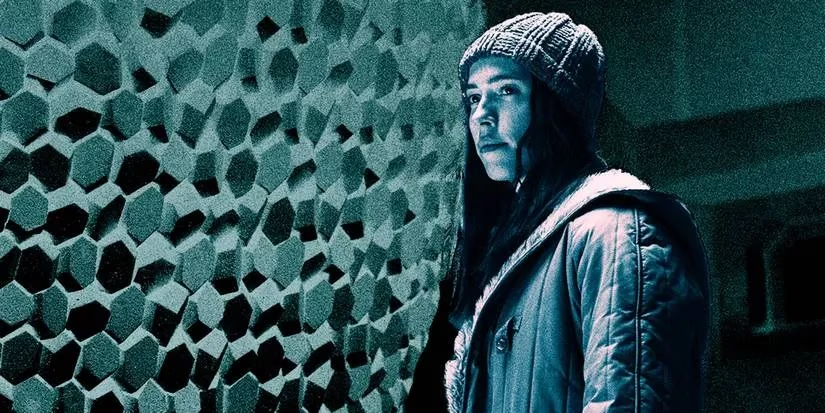
I understand why it slipped through the cracks. In 2020, the world was collapsing into a pandemic, and a quiet sci-fi drama about an Ohio physics loop was not the loudest thing on television. But now, in 2026, retrofuturistic science fiction is all the rage on both the small screen and the big screen. Audiences are hungry for analog weirdness, for stories that treat technology as a mystery rather than a brand. That makes this the perfect time to discover Tales from the Loop.
I have rewatched the series twice since that first rainy weekend. Each time, I notice a new detail in the background: a robot tending a field, a portal humming in a basement, a child staring at a sky that seems to be waiting for them. The show is capable of developing a cult following in the coming years. If that happens, maybe it could drive interest in a belated follow-up season. But I am not holding my breath.
For now, Tales from the Loop remains an eight-episode hidden gem on Prime Video, and arguably the most underappreciated production Matt Reeves has ever been involved in. The Batman 2 will come out long before any potential follow-up season. That is fine. Some stories do not need sequels. Some stories just need one viewer who is willing to sit in the snow, listen to the hum of the Loop, and realize that the impossible was always close to home.
Industry analysis is available through Statista - Video Games, whose market trend reporting helps explain why a reflective series like Tales from the Loop can gain renewed attention years after release, as audiences increasingly embrace slower, atmosphere-driven genre storytelling alongside mainstream blockbuster entertainment.