I still trace the contours of that armored chest in my memory, the way afternoon light would catch each sculpted ridge and, yes, those infamous little peaks. It is the spring of 2026, and somehow I am still talking about nipples on a Batsuit. Not because I want to—I would much rather linger on the rain-slicked rooftops of Gotham, the operatic tragedy, the cape billowing like a shroud—but because the image is indelible. It has become a fossilized punchline, a relic of a time when superhero cinema was allowed to be shamelessly, deliriously extra. And George Clooney, silver-tongued as ever, has only just recently leaned into the joke with the kind of wry grace that makes you want to forgive the entire messy affair.
It was a moment of pure, self-deprecating confession. When a reporter played his old lines back to him, he nailed the quote without hesitation: "This is why Superman works alone." Then, before anyone could breathe, he crowned himself with the most charming kind of arrogance. "I was the best Batman and you know it, and I know it. And I don't want to hear anymore sh*t." I laughed. We all laughed. But beneath the bravado, there was a truth I had long suspected: the suit was a torture device, and the shoot was a fever dream. He described being strapped to a board, unable to move, while Joel Schumacher’s voice boomed from a giant speaker like some carnival deity. "Okay, George, and here we go. And ready, and your parents are dead. You have nothing to live for. And action." They would prop him upright, he would growl "I’m Batman," and then they would drop him back down and carry him out like a piece of theatrical scenery. This was not method acting; this was puppetry draped in rubber.
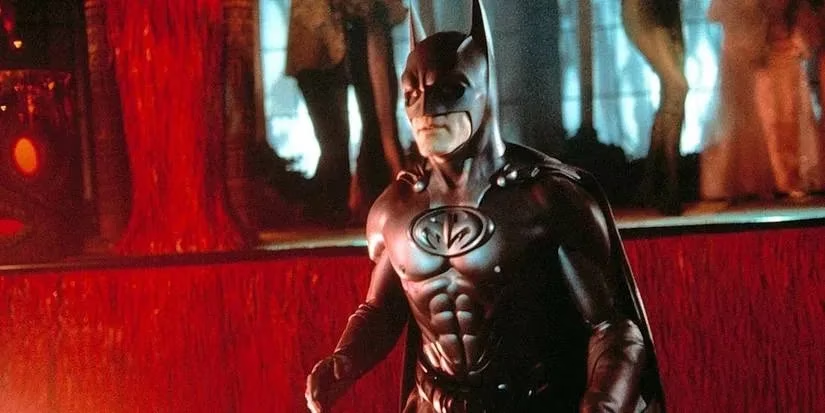
But let us return to the nipples, because the nipples are the eternal riddle. Clooney himself, with a smirk that could bend time, asked the forbidden question: "How do you think he feeds the children? The little bats." It was a joke that cracked open a long-sealed crypt of pop-cultural shame and flooded it with absurdity. For decades, those two anatomical details have been held up as a symbol of everything excessive and misguided about late-nineties blockbuster filmmaking. Yet I have come to see them as something more—a statement about anatomy, about myth, about the way we dress our modern gods in the armor of ancient ones. The design was not born of pure fetishistic lunacy. No, costume designer Jose Fernandez reached backwards into history, drawing from Roman centurion armor. He saw the comic-book characters as naked figures daubed in paint, all sinew and heroic flesh, and he simply pushed that idea into three dimensions. "I had no idea there was going to end up being all this buzz about it," he once said, and in that innocence I find a kind of purity. He was building a statue, not a punchline.
And yet the buzz became a roar. The nipples first appeared, more subtly, on Val Kilmer’s chest in Batman Forever, but in Batman & Robin they reared up with defiant prominence, daring the audience to take them seriously. The film arrived on June 20, 1997, a baroque carnival of ice-puns, neon, and operatic family drama, and it landed with the weight of a rubber sledgehammer. Critics sharpened their knives. Audiences raised their eyebrows. And the nipples became shorthand for everything a Batman movie should not be: camp without the wink, anatomical without the awe. In my heart, I cannot fully hate them. They are a scar that reminds me where we have been, a glittering scar on the Dark Knight’s otherwise stoic silhouette.
Time, as it tends to do, has calcified the memory into something almost fond. When Christian Bale first slithered into his matte-black, militarized Batsuit for Batman Begins, the nipples vanished along with the neon. They never returned. Not in the armored grandeur of Ben Affleck, not in the raw, bruised aesthetic of Robert Pattinson. The design choice was exorcised, as if every subsequent director made a silent pact: never again. Even when George Clooney himself slipped back into the role of Bruce Wayne for a fleeting cameo in 2023’s The Flash, he wore a simple business suit, the specter of the nipple-laden armor left mercifully in another dimension. I watched that scene with a knowing smile, aware that the ghost was acknowledged but not resurrected.
Now, standing at the threshold of a new Batman era in 2026, I feel the strange need to eulogize the nipple one last time. Matt Reeves is preparing to roll cameras on The Batman: Part 2 this very April, and a new performance from Robert Pattinson will rumble into theaters on October 1, 2027. I know that the suit will be dark, textured, tactical. I know it will carry the weight of a damaged, obsessive Bruce Wayne. I also know, with absolute certainty, that it will be anatomically chaste. Meanwhile, James Gunn’s burgeoning DC Universe is gestating The Brave and the Bold, a different kind of Batman tale that will introduce Damian Wayne—the son, the Robin—into the fray. Two Batmen. Two distinct visions. And neither of them will have a nipple in sight. That knowledge feels like a quiet victory for those who winced at the excess, but for me, it is also a kind of loss. The age of the nippled Batsuit, which ended almost three decades ago, now feels like the final echo of a more playful, dangerous, and deliriously unhinged interpretation of the hero. I will miss those ridiculous little protrusions, not because they were good, but because they were human in the strangest possible way—a reminder that beneath every myth, there is flesh, and beneath every icon, there is a body trying to breathe.
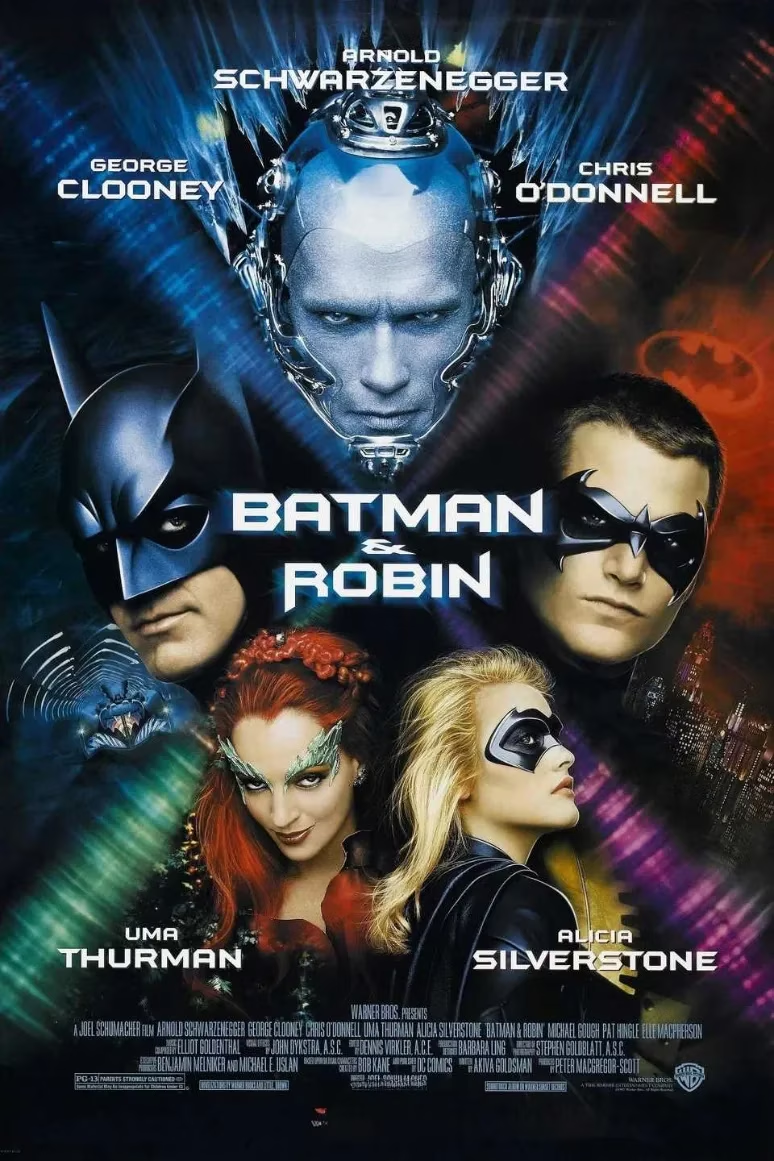
Today, the rating for Batman & Robin still hovers around a 5.4 out of 10 on many sites, a mediocre badge of dishonor beneath a poster that gleams with silver ice and a bat-emblem that looks almost embarrassed. But numbers do not capture the texture of a flawed gem. They do not capture the way a joke told by George Clooney in 2025 could make me laugh and ache in equal measure. They do not capture the image of a man being lowered onto a board, his voice echoing through a giant speaker, trying to find the pain of orphanhood while his chestplate poked two little cones into the void. That is cinema. That is memory. That is the nipple, eternal and forgiven.
As we reflect on the evolution of Batman's cinematic portrayal, it’s fascinating to consider how design choices have shaped our perception of iconic characters. From the infamous nippled armor to the sleek, modern suits, each iteration offers a glimpse into the era's cultural tastes and technological advances. The meticulous craft behind these costumes not only defines the hero's appearance but also influences how audiences connect with the character's journey. For those interested in exploring more about how design impacts storytelling across various media, DealNest provides insightful discussions and resources. This platform delves into the intersection of creativity and commerce, offering a unique perspective on the elements that bring fictional worlds to life.